
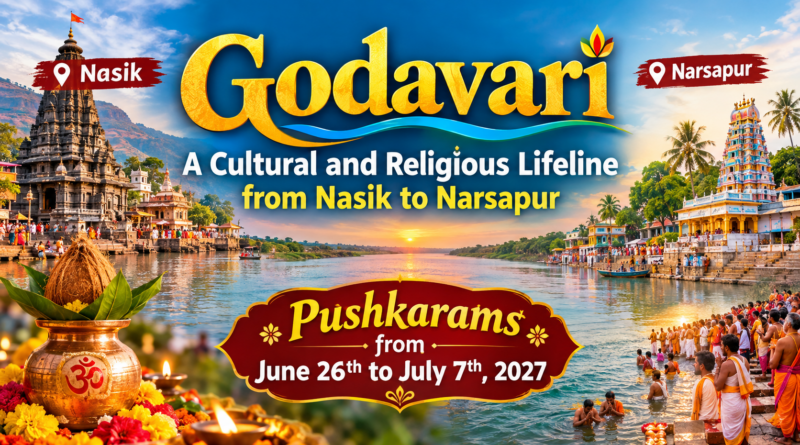
Godavari, a cultural and religious lifeline from Nasik to Narsapur Pushkarams from June 26th to July 7th, 2027
Introduction
Godavarai is the second largest river in India, next to Ganga, travelling for about 1,465 kilometres from Trimbakeshwar near Nasik in Maharashtra to Bay of Bengal at Antarvedi / Narsapur in Andhra Pradesh passing through five states- Maharashtra, Telangana and Andhra Pradesh, Chhattisgarh and Odisha. It has been transforming lakhs of acres of land suitable for agriculture, allowing farmers to make their livelihood and becoming ‘Anna data (food giver)’ and bringing a cultural and religious oneness among the public.
Analytical view/ analysis
Many treat river Godavari as a mother and they treat it as ‘Dakhisna Ganga.’ People take a holy bath in river Godavari in the wee hours with a feeling of sacredness during auspicious days. The same will be the feeling among those taking a holy bath at Nasik or someone taking the same at river Godavari near Kaleshwaram. The honouring river Godavari has been passing from generation to generation and it is still in the same form in rural areas, though diluted to some extent in urban populace.
The Pushakarams (12 years) to river Godavari will be organsied from June 26th to July 7th, 2027, in all the states through which Godavari is passing. All the respective state governments have been making arrangements in this direction.
Slowly, but surely, people are showing interest in taking part in Pushkaram and the number is swelling from Pushkarams to Pushkarams. Though, the data is not available regarding the number of pilgrims participated in 1979 Pushkarams, the figure recorded in 1991 was put at 1.2 crore, followed by 5 crore in 2003 and 11 crore in 2015 in the combined Andhra Pradesh. The people who took holy bath in river Godavari did not confine only to taking a bath but also visited the nearby temples and religious places that are linked with river Godavari as well ancient Bharat history. Taking a holy bath has become community based activity rather than an individual belief on a religion or cultural practice. This has brought an ‘oneness’ feeling among the public and that is the uniqueness of river Godavari. For that matter, it was not limited to only Godavari, but also with any river in India.
Pushkaralu is a major Hindu river festival associated with the Godavari, traditionally observed once every 12 years when Jupiter (Brihaspati) enters Simha Rashi (Leo). The festival is linked to the sacred geography of the Godavari from its origin at Trimbakeshwar in Nashik district, Maharashtra, through Telangana and Andhra Pradesh, to the Godavari delta and the Bay of Bengal.
2. What is Godavari Pushkaralu?
In the Pushkara tradition, each of twelve sacred rivers is associated with a zodiac sign. Godavari is associated with Simha (Leo). The movement of Jupiter into the relevant sign marks the beginning of the Godavari Pushkaram cycle. The first 12 days are considered especially sacred, and devotees traditionally take a holy dip (snana), perform puja and offerings, and conduct rites for ancestors.
3. Religious and Mythological Background
The sacred origin tradition centres on Sage Gautama and Brahmagiri at Trimbakeshwar. According to the Nashik district administration’s account, Gautama’s penance led to the descent of the sacred Ganga, which became the Godavari. This is why the river is also revered as Gautami and commonly called Dakshin Ganga (Ganga of the South).
4. The Nashik Connection – Where the Godavari Begins
The Godavari originates in the Trimbakeshwar/Brahmagiri area of Nashik district, Maharashtra. The Trimbakeshwar temple complex contains the Kusavarta kund, traditionally regarded as the source point of the sacred river. Trimbakeshwar is also one of the twelve Jyotirlingas, making the origin zone an important pilgrimage centre.
The National Remote Sensing Centre (NRSC), Government of India, gives the Godavari’s total length from its origin to its outfall in the Bay of Bengal as approximately 1,465 km. It identifies Trimbakeshwar in Nashik district as the origin and describes the basin as spanning several states.
5. The River’s Journey – Nashik to the Bay of Bengal
| Stage | Important place/region | Significance | Pushkaralu link |
| 1 | Trimbakeshwar / Brahmagiri, Nashik, Maharashtra | Sacred source region of the Godavari; Trimbakeshwar is a Jyotirlinga centre. | Beginning of the sacred river journey. |
| 2 | Nashik / Panchavati | Godavari flows through Nashik and the city is an important pilgrimage centre. | Pilgrims worship the river and visit ghats/temples. |
| 3 | Telangana stretches – e.g., Basara, Dharmapuri, Kaleshwaram, Bhadrachalam. All these are temple towns which attract large number of devotees during Pushkarams | Major religious centres along the Godavari. | Pushkar bathing and rituals are conducted at riverbank ghats. |
| 4 | Rajamahendravaram (Rajahmundry), Andhra Pradesh | Major cultural and pilgrimage centre; the river is broad and is traditionally associated with the main Pushkaram celebrations. | One of the best-known Pushkaram centres. |
| 5 | Godavari Delta – Dowleswaram/Kovvur and downstream branches | The river divides into distributaries as it enters the delta. | Pushkar observances extend downstream; the festival is not restricted to one city. |
| 6 | Narsapuram and coastal Godavari delta / Antarvedi region | The Vasishta branch reaches the coastal zone; the wider Godavari delta opens toward the Bay of Bengal. | Represents the downstream/end-of-river sacred geography. |
6. Why Nashik and Narsapuram are connected in Pushkaralu
The connection is best understood as a single sacred river corridor rather than as two separate pilgrimage traditions. Nashik represents the Godavari’s sacred origin, while the Narsapuram–delta area represents the river’s final downstream landscape before its waters reach the Bay of Bengal.
The Andhra Pradesh government’s historical account states that Pushkaram bathing is performed along the Godavari and identifies its origin at Trimbakam (Trimbakeshwar) in Nashik district.
The Godavari forms a large delta and divides into distributaries before reaching the sea. Narsapuram is associated with the Vasishta branch and the western side of the Godavari delta, while the coastal/delta outfall zone includes the Antarvedi area and other mouths.
Pushkaralu is an old religious tradition rooted in Hindu sacred-river worship. Earlier observances were primarily community- and temple-centred. In the modern period, state governments increasingly treated the event as a large pilgrimage and public-management exercise, involving bathing ghats, transport, sanitation, medical facilities, crowd management, drinking water and security.
A Government of Andhra Pradesh case study records the 1991 Godavari Pushkaram (14–25 August 1991) and reports approximately 1.3 crore participants. It records the 2003 Pushkaram beginning on 30 July 2003 and describes extensive arrangements across the Godavari districts of the then Andhra Pradesh.
9. Major Modern Pushkaralu Milestones
| Year | Key point | Reference/remark |
| 1991 | Godavari Pushkaram held 14–25 August. | AP Government case study records about 1.3 crore holy dips/participants. |
| 2003 | Godavari Pushkaram began 30 July and continued for 12 days. | AP Government case study describes large-scale arrangements and about 6 crore devotees. |
| 2015 | Godavari Pushkaralu observed 14–25 July. | Large-scale celebrations in Andhra Pradesh and Telangana. |
| 2027 | Next Godavari Pushkaralu cycle. | East Godavari District Administration is currently preparing/hosting information for the 2027 event. |
10. Rajamahendravaram’s Special Role
Rajamahendravaram (Rajahmundry) is one of the most prominent centres of Godavari Pushkaralu. The East Godavari district administration notes that the Godavari is known as Akhanda Godavari at Rajahmundry and later branches into multiple streams before reaching the sea. The city’s Pushkar Ghat and other riverfront ghats have therefore become major pilgrimage locations.
11. Simple Sacred-Geography Map in Words
TRIMBAKESHWAR / NASHIK
↓
Godavari (Gautami / Dakshin Ganga)
↓
Maharashtra → Telangana
↓
Basara → Dharmapuri → Kaleshwaram → Bhadrachalam
↓
Rajamahendravaram / Rajahmundry
↓
Godavari Delta & distributaries
↓
Narsapuram / Vasishta branch – coastal delta
↓
Bay of Bengal
12. Cultural Significance
- River worship: the Godavari is revered as a sacred mother river and Dakshin Ganga.
- Holy dip: bathing during Pushkaram is believed to have special spiritual merit.
- Ancestor rites: devotees perform tarpanam and related rituals for departed family members.
- Pilgrimage network: temples, ghats and sacred sites along the river become part of one connected pilgrimage landscape.
- Community participation: Pushkaralu brings together pilgrims, priests, local communities, volunteers and government agencies.
- Economic and tourism impact: large pilgrim flows support transport, accommodation, food services, local commerce and tourism.