
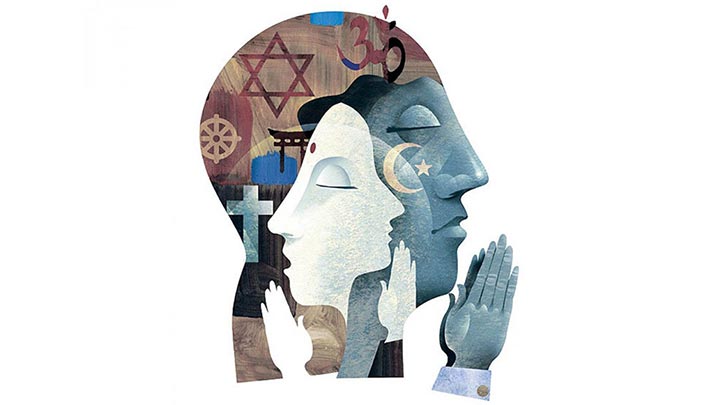
What religious conversion means for SCs?
Bharat is a vast country since generations with different regional cultures and different practices but with oneness among the public. Though different kings ruled parts of their territories at various times and physically the people belong to different countries, they never felt alien to others, as their broader perspective is the same about the nature, God and fellow human beings. The thought of religious conversion was not there even in the wildest dreams of the public as they practiced only one religion – that is Hinduism.
This is Akhand Bharat, which included Afghanistan, Pakistan, Bangladesh, India, Bhutan, Nepal, Sri Lanka, Maldives and Myanmar. Thailand, Indonesia, Cambodia, Vietnam and Malaysia are also once part of the nation spread among different kingdoms but practiced oneness culturally and religiously.
However, the early traces of religion can be found in between 7th and 8th century when Arab businessmen entered India through the coastal areas Malbar coast in Kerala and Gujarat. Being far off from the native countries and still practicing their own religions – the Arab traders converted some vulnerable section – (may be economically and socially weak) of people to their religions. Here the conversions were not forced conversion but luring them with benefits if they convert into their religions.
Nevertheless, after few decades the situation has changed drastically with the Arab invasion of Sindh area between 8th and 12th centuries beginning with Muhammad Bin Qasim. From here on one can trace the forced religious conversions in the Indian sub-continent, as Islam become the ruling religion in some parts of the country. Later, the invasion of India continued by the rulers of Islamic who forced their way for religious conversions.
The Christianity entered India in three phases. The first was apostolic era. This is early foundation period of Christianity from 30 AD to 100 AD. According to information available, St. Thomas Apostle had arrived Cranganore (Kodungallur) in the Malbar Coast of Kerala in 52 AD to propagate Christianity.
The second one was Portuguese Era –commenced after 1510 when the Portuguese seized Goa and made it as part of their expansion activities. Records states that about 25 per cent of Goa population converted into Christianity. Portuguese rulers have deployed Missionaries for this specific purpose and the methods they followed include – coercion, Portuguese citizenship, government employment, inheritance to assets despite having Hindu siblings, restricting religious practices and Hindu temples.
The third and most important phase was that British Missionary Era was from 18th century to 20th century beginning with East India Company rule to British Rule. During this period, evangelists – Anglicans, Baptists and Presbyterians – arrived in the country and preached their religion. The powerful East India Company and later the British Kingdom backed them through their power and money.
Even after 75 years of independence, the religious conversions are continuing unabated due to various reasons including some political parties not finding anything objectionable under ‘secularist perspective.’
Support to Christianity in Andhra Pradesh
The state of united Andhra Pradesh has reportedly witnessed an encouragement for conversion of SCs into Christianity during the tenure of former chief minister Y.S. Rajasekhara Reddy while Congress was in power between 2004 and 2009. During this tenure even the Tirumala Tirupati Devasthanam become a point of controversy and reported of effort of Rajasekhara Reddy to construct a church on one of the Seven Hills of Lord Venkateshwara.
https://www.opindia.com/2021/02/the-state-sanctioned-christianisation-of-andhra-pradesh-a-primer/
Later, in the residual Andhra Pradesh under the leadership of YSRCP leader Y.S. Jaganmohan Reddy between 2019 and 2024. While being in the position of Chief Minister, Jaganmohan Reddy had doled out freebies to pastors and encouraged construction of churches. The Government has extended financial assistance for about 30,000 pastors during the Jaganmoahn Reddy tenure and it is continuing in the present ruling of N. Chandrababu Naidu.
Supreme Court Judgement
Few months ago, on March 24th, 2026, the Supreme Court of India had delivered a judgement, in which it stated that, ‘the Christianity does not by its very theological foundation recognise caste. It relied on the New Testament, Galatians 3:28. There is neither Jew nor Gentile, neither slave nor free, nor is there male and female, for you are all one in Jesus Christ.” The Court said that the social and economic disabilities arising because of Hindu religion once a person converts from Hinduism to Christianity, as per Constitution Bench Decision in Principal Guntur Medical College Vs Y Mohan Rao (1976) and three – judge bench in CM Armugam Vs S. Rajagopal (1975)
The case pertains to one Chintada Anand, who was born in to Madiga Community, a Scheduled Caste in Andhra Pradesh. After converting into Christianity, he worked as a pastor and offered Sunday prayers for about a decade. In 2021, Anand filed a case against some persons from local community accusing that they have abused him in the name of his cast and assaulted. With 16 witnesses, police filed a charge sheet and a tahasildar confirmed that he is Hindu Madiga.
A bench of Andhra Pradesh High Court quashed the FIR under SC/ST (Prevention of Atrocities) Act stating that the cast system was alien to Christianity and the IPC allegations lacked justification.
Dismissing the appeal filed by Anand, the Supreme Court bench, consisting of Justice P.K. Mishra and Manmohan, said that ‘religious conversions results in immediate and complete loss of Schedule Caste status from the moment it occurs, regardless of birth. By extension, all the statuary benefits terminate automatically, and upheld Andhra Pradesh High Court view.
Madras High Court ruling
During last month, June 2026, the Madurai Bench of Madras High Court delivered similar judgement in the case of Muslim claiming BC Muslim status. It has also quashed a GO issued by the government allowing converts claiming such status.
Here is the report published in The Hindu on June 26, 2026
The court was hearing the petition filed in 2022 by a man from Thoothukudi district who had embraced Islam and changed his name. He was born to Hindu parents. The certificate issued by the Sunnath Jamath, Kayathar, in 2015 stated the petitioner had embraced Islam.
He had applied for a community certificate certifying him as ‘Muslim Lebbai,’ a faith, he claimed to follow. However, the Kayathar Tahsildar rejected his application. Challenging it, he moved the court.
Meanwhile, a G.O. issued in 2024 ordered that a convert to Islam from Backward Classes, Most Backward Classes, Denotified Communities or Scheduled Castes may be treated as BC (Muslim) for availing the benefit of reservation and on such conversion, (s)he may be issued with community certificate as belonging to one of the notified seven sects.
However, the State said, a convert from a forward community to Islam would not get the BC (Muslim) tag. Only those who already enjoyed the benefit of reservation in their original religion would not lose it on account of conversion to Islam. Social balance will not be affected, it was submitted.
A Division Bench of Justices G.R. Swaminathan and P.B. Balaji said as early as in 1951, the Madras High Court held that when a Hindu gets converted to Islam, he becomes just a Mussalman and his place in Muslim society is not determined by the caste to which he belonged before his conversion. It was further held that a member of one of the castes or sub-castes when he is converted to Islam ceases to be a member of any caste. The decision was approved by the Supreme Court.
The court said Christian missionaries as well as Islamic preachers harangued through decades and centuries that their religions offer social equality unlike Hinduism which has caste as its inherent feature. “Having taken such a stand for effecting conversions, it is disingenuous to claim that there is hierarchy in Islam also. In our respectful view, categorising certain sects as Backward and the remaining as Forward is antithetical to Quranic injunctions. Islam seeks to establish an egalitarian society. Everyone is equal in the eye of God. There is no social hierarchy,” the court said.
“Be that as it may, due to historical reasons, the Islamic society is also stratified into various communities. One can even boldly remark that they are akin to caste in Hinduism. Just as caste is determined by birth, one is a Rowther or Marakkayar or Deccani Muslim by birth alone. It is ridiculous to suggest that one can be converted into a Rowther Muslim,” the judges said.
The order said as held by the Division Bench of the Madras High Court more than 75 years ago, upon conversion to Islam, one becomes a Muslim. The Division Bench used the expression ‘just a Mussalman’. He cannot be pigeonholed into any particular sect or community which can be only by virtue of one’s birth therein. When the proposition laid down by the Division Bench is holding the field, it cannot be undone by issuing a mere government order.
“The doctrine of separation of powers is an entrenched principle in the Constitution and that it is an essential constituent of rule of law. This principle applies to the final judgments of the courts. The legislature cannot declare any decision of a court of law to be void or of no effect,” the court said.
Against this backdrop, it is not open to the State government to issue a G.O. undermining the decision.
“That is exactly what the government has done by recognising that there can be conversion to any one of the seven sects of Muslims identified as Backward Class Muslim. The sheer arbitrariness of the impugned G.O. becomes manifest for one more reason. The Backward Classes Commission’s recommendation as well as the G.O. provide for accommodating BC/MBC/DNC/SC convertees in any one of the seven slots. A SC who is at the bottom-most rung of the social ladder is put on par with a BC. The Supreme Court in a catena of decisions has held that OBCs and SCs form separate categories,” the court said.
Just for the sake of ensuring the converts to Islam continue to enjoy some form of reservation benefit, such a bunching has been done by the State government. This exposes the inherent flaw in the approach adopted by the government, the court said.
“We have no option but to conclude that only to undo the judgments of the court, has the government come out with an innovation that is not only unconstitutional but also un-Islamic. Once we find that the G.O is illegal, it is our bounden judicial duty to declare it to be so. We accordingly declare that the G.O is unconstitutional,” the judges said and disposed of the petition.
Both these judgements clarify that conversion to any religion, particularly to Christianity and Islam; from Hinduism will automatically clutch their earlier caste status and its benefits. This will have long drawn impact on those who got government jobs in the name of a particular caste and then practicing another religion in day today life.
Eom/Avadhani